
Agentic AI for Dealerships: You Just Got Promoted
Everybody in that room got promoted. That's what I told a room full of commercial truck dealers at the Fall 2026 CVB Summit. Whatever your title was yesterday, you're now a director. Maybe a VP. Because agentic AI just handed you a team that works 24/7.
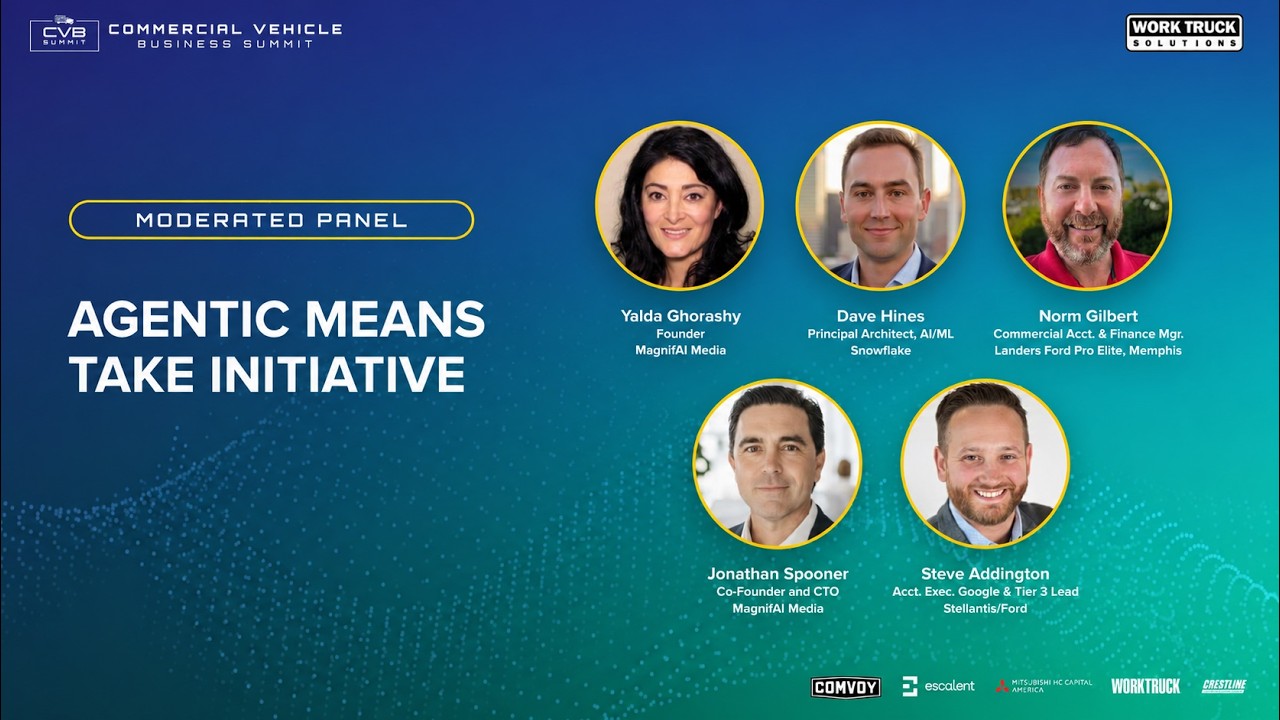
Work Truck Solutions invited me to speak on their panel, "Agentic Means Take Initiative," and I got to represent MagnifAI Media. The full 56-minute session is below.
Watch on YouTube: Agentic AI for Dealerships: Real Uses, Better Data & Guardrails
I shared the stage with a strong group. Dave Hines, principal architect for AI and ML at Snowflake, covered the data layer. Steve Addington from Google Ads brought the view from search. Norm Gilbert, commercial account and finance manager at Landers Ford in Memphis, kept all of us honest from the dealership floor. Yalda moderated.
Here's what stuck with me.
Chatbots React. Agents Take Initiative.
Everyone is slapping "agentic" on their product this year. The real difference is simple. A chatbot waits for you to ask. An agent goes to work without being asked.
Running these things is now cheap enough that we can check every campaign, every hour. At 2 a.m. on a Saturday. In every language. That's not a better chat window. That's a team.
You're a VP Now. Act Like One.
"I just want to congratulate everybody in this room, because you are now promoted. Everybody in here is two levels up." — Jonathan Spooner, MagnifAI Media
Dave and I both write software. At some point in a software career you become a director of engineering, and suddenly your job is leading people instead of typing code. That shift is now happening to everyone, at every level.
You still need to know your domain. You're still accountable for the work, just like you're accountable for your team. But your job is delegation now.
Start with two agents:
- A research agent. Low risk. Its only job is to go collect information and bring it back.
- An assistant agent. Let it read your email. Talk to it on your morning walk. It drafts the replies, and you edit and send them from your desk.
Then set a weekly goal. Add one new agent. Tune up another one. Dave's advice for getting started was even simpler: open Claude Code, Codex, or Gemini and type "I want to create an agent to do X." That's your starting point.
A Dealer Who Actually Did It
Norm stole the show, because he isn't a developer. He's a commercial truck salesperson who sat down and built this stuff.
Dealer trades used to eat his day. Search Ford's system for a unit, find the dealer, grab their contact info, call or email, repeat for 12 or more dealers. He built an agent with Muse that searches inventory, captures the invoice, and drafts the email. It took him three to four hours to set up. It saves him dozens of hours.
"Three, four hours' worth of input is going to save me dozens of hours of output on the other side." — Norm Gilbert, Landers Ford
Quotes changed too. A repeat customer calls: "Same truck as last year. Send me pricing." Norm drops build sheets, price sheets, and current incentives into NotebookLM, prompts for an F-250 crew cab with the right engine and features, and gets pricing plus a presentation deck in seconds. The customer has a PDF in their inbox within five minutes of hanging up. That used to take an hour or more.
And Norm still hits send on everything. Keep that in mind.
Your Buyer Showed Up Hyper-Educated
Steve dropped a stat that should change how every commercial dealer thinks about advertising: 83% of commercial truck searches don't contain a make or a model. People are asking things like "What's the best work van for my paint company? I need room for five-gallon buckets, a sprayer, and an air compressor."
The intent hasn't changed. Buyers still want to buy a truck. They just show up a whole level deeper in the funnel. It used to be "I want a work van." Now it's "I want this VIN, at this price."
That's a good thing. But the store has to be ready to catch them. Norm put it best: the tools changed, but the relationship didn't.
"We're not in the car business, we're in the people business. I have AI just like they do. I just use it a little differently." — Norm Gilbert, Landers Ford
Put the Salesperson in Control of the Ads
This is what we're building at MagnifAI Media. We call it self-directed advertising. A salesperson chats directly with an agent that's an expert in Google Search and the other channels, and directs the advertising themselves.
Behind that conversation, agents watch every campaign, your inventory, and your CRM around the clock. They balance it all against your campaign objectives. No waiting on the agency's Tuesday meeting.
Own Your Data First
None of this works if you don't control your data. Own your Google Ads account. Own your Google Analytics account. Then get copies of everything into one place that you own.
Our product gives every store its own data room. Our agents fill it with documents about every piece of the business, and you can read it and make decisions from there. Dave pushed this further: give your agents a map of what your data means and how it connects, inventory to leads to sales. Otherwise your agent walks the maze on its own. That's expensive, and risky.
Norm made the point that you can start small. Pull last year's customers into a simple list and have an agent write a stay-in-touch campaign. Same process. Smaller scale.
Where the Guardrails Go
Everyone on the panel agreed on one line: no agent quotes prices on its own yet. An expired incentive or a misread rebate gets you held to a number you can't honor. That's a legal problem, not just a negotiation problem.
Steve uses a 20-60-20 rule. A human does the first 20% (setup) and the last 20% (dotting the i's). The agent does the 60% of shovel work in the middle.
"You set it up. You do your due diligence. You take that extra 20% to cross your t's and dot your i's. But that middle shovel work, that 60%, let the agent do that." — Steve Addington, Google
Dave learned this the hard way. His personal agent was booking golf tee times and grabbed about 30 of them across Denver for the same Sunday morning. Now the agent brings him the link, and he makes the final call.
Dave's bigger warning is the one dealers should hear. Your customers' agents are coming. They'll call, text, and email your store 24/7 asking for prices. Paying humans to answer bots is a losing game. Dealers will need their own agents playing defense, steering those conversations toward a real human and a real deal.
"I should have an agent playing defense on my behalf. Guardrailing that conversation away from any sort of agentic transaction, but driving it towards the transaction you want." — Dave Hines, Snowflake
Kick the Tires
Norm's closing advice was perfect. Pick one tool. Gemini, Muse, ChatGPT, whatever. Ask it, "What questions should I be asking you?" And always keep the last say before anything goes out the door.
How many hours did your sales team spend this week on work an agent could have done overnight? Email me at jonathan@rubygrowthlabs.com with the subject "Dealer agents" and tell me what your store's busywork looks like. I'll tell you which agent to build first.